
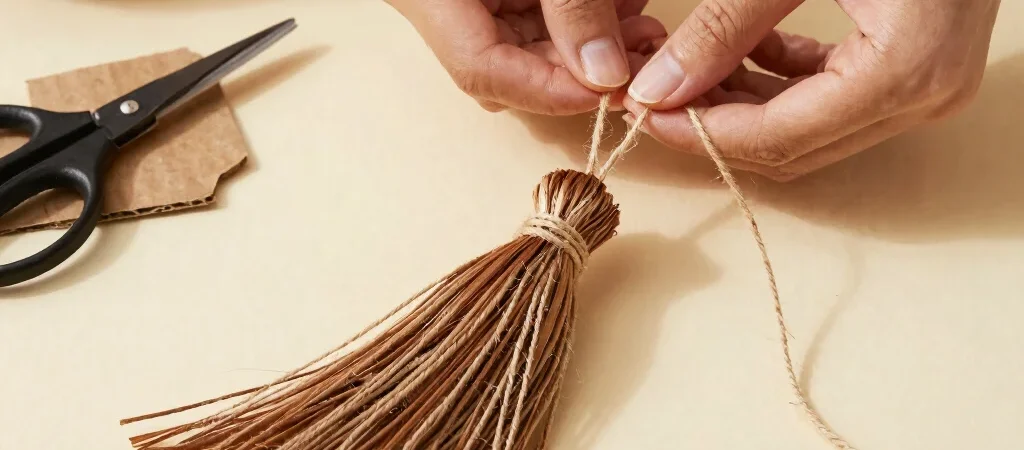
Loose coconut coir fibers don’t behave like smooth yarn: they separate, catch, and refuse to fall into a perfect fringe. That makes them a good material for a rustic tassel where texture is the point. Set out loose coir fiber or coir yarn, cotton twine, a piece of scrap cardboard, and sharp scissors.
Prepare a Simple Guide
Cut the cardboard slightly longer than the finished tassel you want, allowing extra length for trimming. Lay the coir along its length and wrap it around the card several times, keeping the bundle loose enough to slide off. If you’re using loose fiber rather than yarn, gather small lengths together as you wrap so the strands don’t drift apart.
Tie and Shape the Bundle
Slide a length of cotton twine beneath the wrapped coir at one end and tie it firmly to create the hanging loop. Cut through the coir at the opposite end of the cardboard, then wrap another piece of twine around the bundle just below the loop to form the tassel neck. Knot the twine securely and leave its ends long enough to tuck into the fibers.
Trim for Natural Movement
Comb through the coir gently with your fingers, separating any strands that have stuck together. Snip the ends to even the shape, but keep a few uneven fibers if you want a softer, more handmade edge. Use the finished tassel as a decorative tie or hanging accent, and expect some loose fibers as the natural material settles.
A small test bundle is useful before making a larger tassel, especially when the coir fibers vary in length. Browse Semilircraft’s materials for coconut coir and other natural fibers, then choose the texture that suits the finish you have in mind.